Simple Feed
November 25, 2025
Unlocking Wealth: Smart Advice for Property Investors

Why Commercial Property Investment Builds Lasting Wealth
Investing in commercial property is one of the most reliable ways to build long-term wealth. Unlike residential properties, commercial buildings—such as office spaces, retail centers, or industrial facilities—often generate higher rental income and have longer lease terms. This stability provides a steady cash flow while protecting your investment against short-term market fluctuations, making it easier to plan for long-term financial growth.
Beyond consistent income, commercial properties also tend to appreciate over time, offering the potential for significant equity gains. Investors can benefit from tax advantages, including depreciation and deductions for property expenses, which further enhance returns. With careful management and strategic location choices, commercial property investment can serve as a foundation for lasting wealth that grows steadily for decades.
Here’s what you need to know to get started:
Key Investment Advice for Commercial Property:
- Start with Financial Assessment – Understand your borrowing power and capital requirements before searching for properties.
- Research Your Market – Focus on high-growth areas with strong economic indicators and low vacancy rates.
- Diversify Your Portfolio – Spread risk across different property types (office, retail, industrial) and locations.
- Plan for All Costs – Budget for down payments, ongoing expenses, and emergency reserves.
- Build Your Network – Connect with experienced brokers, property managers, and fellow investors.
- Think Long-Term – Commercial real estate rewards patient investors who focus on steady cash flow and appreciation.
Valued at over $230 trillion globally, commercial real estate is the world’s largest asset class. For investors in Southern California, particularly the Inland Empire, it offers a tangible path to passive income and long-term wealth. Commercial properties stand out for their longer lease terms, higher income potential, and historically lower vacancy rates. Asset types like office buildings, retail centers, and industrial warehouses each offer distinct advantages for savvy investors.
Success requires more than capital; it demands a clear strategy, market research, and professional guidance to steer complex transactions. The fundamentals are to buy strategically, manage effectively, and hold for long-term growth.
Foundations of Commercial Property Investment
Commercial real estate is a business, and treating it as such is the first step to success. Commercial property investment starts with understanding the core elements that drive value and long-term returns. Location, tenant quality, lease structure, and property type all play critical roles in determining cash flow and appreciation potential. Unlike residential properties, commercial buildings often have longer leases and professional tenants, providing more predictable income streams and reducing turnover-related risks.
Equally important is financial planning. Investors should consider upfront costs, financing options, ongoing maintenance, and potential tax benefits. By carefully evaluating these factors and aligning them with market trends and personal investment goals, commercial property investment can offer a structured path to wealth creation and portfolio diversification.
Four Main Types of Commercial Properties
The commercial real estate world offers four main property types, each with its own profit potential. Office buildings range from small suites to corporate campuses, and their performance is tied to local employment and business health.
Retail centers include everything from strip malls to major shopping destinations. Success hinges on location, foot traffic, and a strong tenant mix that aligns with consumer spending.
Industrial warehouses are the rising stars in logistics hubs like the Inland Empire. Distribution centers and manufacturing facilities are thriving thanks to e-commerce growth.
Mixed-use properties combine uses like retail and office space, offering diversified income streams but requiring more sophisticated management.
The advantages of commercial real estate are what draw investors to this asset class. Steady cash flow comes from long-term leases (typically 3-10 years), providing predictable income. Property appreciation builds wealth over time through market growth and strategic improvements. Tax benefits like depreciation and 1031 exchanges reduce your tax burden. Leverage allows you to control a large asset with a smaller down payment, amplifying returns. Finally, portfolio diversification adds stability to your overall investment strategy.
Diversifying Within Commercial Real Estate
Diversification is a key risk management strategy in commercial real estate, protecting your portfolio from the volatility of a single property type or location.
- Different property types offer the first layer of protection. Mixing office, retail, and industrial properties helps balance sector-specific risks.
- Geographic diversification within Southern California provides another advantage. The Inland Empire and other submarkets have unique economic drivers, so spreading investments across different cities reduces localized risk.
- Tenant mix is crucial in multi-tenant properties. A diverse range of businesses means that if one tenant struggles, your cash flow remains relatively stable.
Risk management through diversification is practical advice on property investment that protects your wealth. For a deeper understanding, check out More on Commercial Real Estate Diversification.
Your Step-by-Step Guide to Getting Started
Getting started in commercial property investment is a step-by-step process. Let’s walk through the foundational steps to ensure you begin on solid ground.

The most important piece of advice on property investment is to start with an honest financial assessment. A strong credit score (ideally 700+) is crucial for securing favorable loan terms. Lenders will scrutinize your financial health, so focus on a solid payment history and a low debt-to-income ratio.
Regarding capital, expect to need a down payment of 20-30% of the purchase price, plus an additional 2-5% for closing costs. It’s also critical to have a robust emergency reserve of 6-12 months of operating expenses to cover unexpected costs and vacancies. This cushion protects you when a tenant leaves or a major repair is needed.
Next, set clear investment goals. Are you targeting long-term appreciation in a growing market like Southern California, steady monthly cash flow, or value-add opportunities? Your goals will shape your entire strategy. Commercial real estate rewards a patient, long-term approach.
Securing financing is where your preparation pays off. Options include traditional bank mortgages, loans from community banks and credit unions, Small Business Administration (SBA) loans for owner-occupied properties, and private lenders. Each option has different requirements and terms, so research thoroughly to find the best fit for your cash flow and long-term goals.
If you’re uncertain about these steps, our team at IPA Commercial Real Estate has guided countless investors in the Southern California market. For more detailed guidance, check out Getting Started in Commercial Real Estate Investing and explore our Real Estate Investment Consulting services.
Crucial Market Research and Location Analysis
Location is the foundation of every successful commercial property investment. The best advice on property investment is to do your homework before you commit to a building.
For commercial properties in Southern California, this means analyzing economic forces, demographic trends, and future growth patterns. The Inland Empire, for example, has become a logistics powerhouse, and understanding why separates successful investors from the rest.
- Economic Indicators: Examine job and population growth, which signal demand for commercial space. Major infrastructure projects can also transform a region’s real estate dynamics.
- Vacancy Rates: Low vacancy rates indicate strong demand and give landlords pricing power. High rates might signal weakness or a value-add opportunity.
- Zoning and Development: Review local zoning laws and future development plans at the city planning department. This research can save you from expensive mistakes.
- Comparable Properties: Understand what similar spaces are selling and renting for in your target market. This data is your baseline for evaluating deals.
This investigative process is called due diligence. It’s the essential work of verifying a property’s physical, financial, and market standing before you commit capital. Local expertise matters enormously in the unique Southern California market. For deeper insights, explore Inland Empire Commercial Real Estate. When you’re ready to evaluate an opportunity, our guide on How to Evaluate a Commercial Property’s Long-Term Potential can help.
Key Strategies and Essential Advice on Property Investment
Successful property investment combines careful planning with smart strategy. Start by clearly defining your goals—whether it’s steady rental income, long-term appreciation, or portfolio diversification—and choose properties that align with those objectives. Location remains a critical factor: high-demand areas with strong economic growth, accessibility, and nearby amenities tend to attract reliable tenants and maintain value over time.
Beyond location, pay attention to property type, financing, and risk management. Diversifying across residential, commercial, or mixed-use properties can reduce exposure to market fluctuations. Additionally, conducting thorough due diligence, maintaining properties proactively, and seeking professional advice when needed ensures your investment generates consistent returns and builds lasting wealth.

Rental income, or cash flow, is the most direct earning strategy. Rent collected from tenants covers your mortgage and operating expenses, ideally leaving you with positive cash flow. The long-term nature of commercial leases (3-10+ years) provides best stability.
Property appreciation builds wealth in the background. As markets like Southern California grow and you make strategic improvements, the property’s underlying value increases. This gain is realized upon sale or refinancing.
Value-add opportunities involve purchasing an underperforming property and changing it. Through renovations, better management, or repositioning, you can significantly increase its income and market value. Value-add calculations in commercial real estate focus on improving the net operating income (NOI) and capitalization rate to force appreciation.
Measuring success is critical. Use our tools to Calculate Your Commercial Property ROI and understand your Commercial Property Rental Yield Guide. These metrics reveal the true performance of your investments.
Finding the Right Commercial Property
Choosing the right building is where strategy meets reality. Here’s what to look for when evaluating potential acquisitions in Southern California.
- Property Condition: Assess the physical condition thoroughly. While properties needing work can be value-add opportunities, deferred maintenance can be a financial drain. Always budget for professional inspections to avoid costly surprises.
- Tenant Quality and Lease Terms: Analyze tenant quality and lease terms carefully. Financially stable tenants with long-term, NNN leases provide predictable income and reduce risk.
- Growth Potential: Evaluate the property’s future growth potential. This includes opportunities for physical expansion and, crucially, the economic trajectory of the surrounding area. Markets like the Inland Empire offer significant upside due to ongoing development and population growth.
Managing Your Investment and Mitigating Risks
Acquiring a commercial property is just the start. Effective management is how you protect your capital and generate planned returns. Ownership involves ongoing costs, including property taxes, insurance, maintenance, and utilities. Smart investors maintain a capital reserve fund to handle large expenses, like a roof replacement, without disrupting cash flow.
Understanding and mitigating risks is key to long-term success.
- Tenant Turnover and Vacancy: This is a common risk. Mitigate it with thorough tenant screening, competitive lease terms, and strong tenant relationships. An emergency reserve fund is essential to cover expenses during vacancy periods.
- Economic Downturns: Diversification across property types (office, retail, industrial) and geographic locations within Southern California is the best defense. A healthy cash reserve also helps weather lean times.
- Unexpected Repairs: Prepare for large capital expenditures with regular property inspections and proactive maintenance. A dedicated capital reserve fund is non-negotiable for handling these costs.
- Illiquidity: Commercial real estate is an illiquid asset; transactions take months. This requires a long-term investment horizon and a financial plan that doesn’t rely on quick access to this capital.
Understanding these risks prepares you for success. Learn more about How to Analyze Risk Before Purchasing a Commercial Property and find the 5 Common Mistakes That Real Estate Investors Should Avoid.
The Role of Professional Property Management
Every property owner faces a key decision: manage the property yourself or hire a professional. While self-management can work for a single, straightforward property, it quickly becomes a demanding, full-time responsibility as your portfolio grows. Handling tenant issues, maintenance requests, and financial reporting can lead to stress and burnout, especially if you own multiple properties or operate in a complex market like Southern California.
Hiring a professional property management team, such as IPA Commercial Real Estate, is an investment in both expertise and your time. Experienced managers handle critical tasks that protect your investment and maximize returns, including:
- Tenant Screening and Placement: Finding, vetting, and securing reliable tenants to minimize vacancy and reduce risk.
- Rent Collection and Financial Reporting: Ensuring timely payments, maintaining accurate records, and providing transparent financial statements.
- Maintenance and Repairs: Coordinating routine upkeep and emergency repairs with a trusted network of contractors, keeping your property in top condition.
- Legal Compliance: Navigating complex landlord-tenant laws, building codes, and regulatory requirements to reduce liability.
Beyond day-to-day operations, a strong property management team provides strategic insights tailored to the Southern California market. From identifying rent trends to recommending property improvements that boost value, professional managers like IPA Commercial Real Estate turn what could be a stressful responsibility into a seamless, profitable part of your investment strategy. For most investors, professional management isn’t a cost—it’s an investment in peace of mind, smoother operations, and better long-term returns.
Frequently Asked Questions about Commercial Property Investment
Investing in commercial property can feel complex, with questions about financing, tenant management, and long-term returns coming up at every step. To help simplify the process, we’ve compiled answers to some of the most common questions investors have. Whether you’re considering your first commercial property or looking to expand an existing portfolio, this guide provides clear, practical insights to help you make informed decisions and maximize your investment potential.
What are the essential skills for a successful commercial real estate investor?
Success in commercial real estate requires a specific skill set. Key abilities include:
- Analytical Skills: The ability to dissect financial statements, evaluate market data, and calculate key metrics like ROI and cap rates.
- Negotiation: Effectively navigating complex discussions over price, lease terms, and contingencies is critical.
- Market Knowledge: Understanding the economic forces shaping your target market, such as the drivers of growth in Southern California’s Inland Empire.
- Financial Literacy: Grasping financing structures, tax strategies like 1031 exchanges, and the principles of leverage.
- Patience and Long-Term Vision: Commercial real estate is a marathon, not a sprint. Weathering market cycles is part of the process.
- Networking: Building relationships with brokers, lenders, and other investors in the Southern California market often leads to the best opportunities.
These skills develop over time. For more foundational knowledge, refer to our Real Estate Investment Advice for Beginners.
How much capital do I need to start investing in commercial real estate?
This is a common question, and the answer depends on several factors. As a general rule, plan for a down payment of 20-30% of the purchase price. You will also need an additional 2-5% for closing costs. Crucially, our advice on property investment is to maintain a liquid reserve fund of 6-12 months of operating expenses. This cushion protects you from vacancies and unexpected repairs. The exact capital needed varies, so a thorough financial assessment is your first step. For more insights, check out our Advice on Buying an Investment Property.
What are the primary tax benefits of owning commercial investment property?
Commercial real estate offers powerful tax advantages that are crucial to understand.
- Depreciation: This non-cash deduction allows you to recover the cost of the building (not land) over 39 years. It can be claimed even as the property generates cash flow and appreciates, offering a significant tax shield.
- Interest Deductions: The interest paid on your commercial mortgage is fully tax-deductible.
- 1031 Exchanges: This strategy allows you to defer capital gains taxes when you sell an investment property by reinvesting the proceeds into a similar property within a specific timeframe.
- Pass-through Deductions: Depending on your ownership structure, you may qualify for Qualified Business Income (QBI) deductions, further reducing your taxable income.
Tax laws are complex, so always consult a qualified tax professional. Understanding these benefits is key to calculating your true Commercial Real Estate Return on Investment.
Why Choose IPA Commercial Real Estate?
Commercial real estate in Southern California—especially in thriving areas like Riverside and the Inland Empire—is a path to building generational wealth through tangible assets. The combination of steady cash flow, appreciation potential, and significant tax advantages creates a powerful wealth-building engine.
While it requires capital and commitment, a patient, informed approach to commercial real estate can transform your financial future. We’ve seen this happen for countless clients across Southern California.
At IPA Commercial Real Estate, we’re not just brokers—we’re partners in your success. Our team brings decades of experience in brokerage, management, and consulting, all rooted in deep local knowledge of Southern California’s commercial markets. We understand the nuances of the Inland Empire, the opportunities in Riverside, and the strategies that work in our unique market conditions. Our commitment to personalized service means we take the time to understand your specific goals and custom our approach to help you achieve them.
Ready to transform your investment vision into reality? Explore professional property management services that will protect and improve your commercial assets, or reach out to our team for personalized advice on property investment that fits your unique situation. Let’s build your commercial real estate success story together.
November 18, 2025
The Inland Empire Advantage: Unpacking the Region’s Property Market

The Inland Empire: A Commercial Real Estate Powerhouse in Southern California
The Inland Empire has evolved from a logistics corridor into one of Southern California’s most dynamic commercial real estate hubs. With massive population growth, strategic proximity to major ports, and a business-friendly landscape, the region has become a magnet for companies seeking space, scale, and speed. Whether it’s industrial, retail, or office redevelopment, the IE is reshaping how Southern California thinks about expansion.
Today, the Inland Empire stands as a powerhouse of opportunity, driven by record-setting industrial absorption, continued investment in infrastructure, and a growing workforce that fuels long-term growth. As demand pushes outward from Los Angeles and Orange County, developers and investors are finding that the Inland Empire isn’t just a spillover market—it’s a high-performance ecosystem of its own, offering the capacity and momentum modern businesses need to thrive.
Key Inland Empire Commercial Real Estate Facts:
- Industrial Vacancy Rate: 7.6% (Q1 2025) with positive net absorption of 2.2 million square feet
- Sublet Availability: 16.6 million square feet, reflecting major market activity
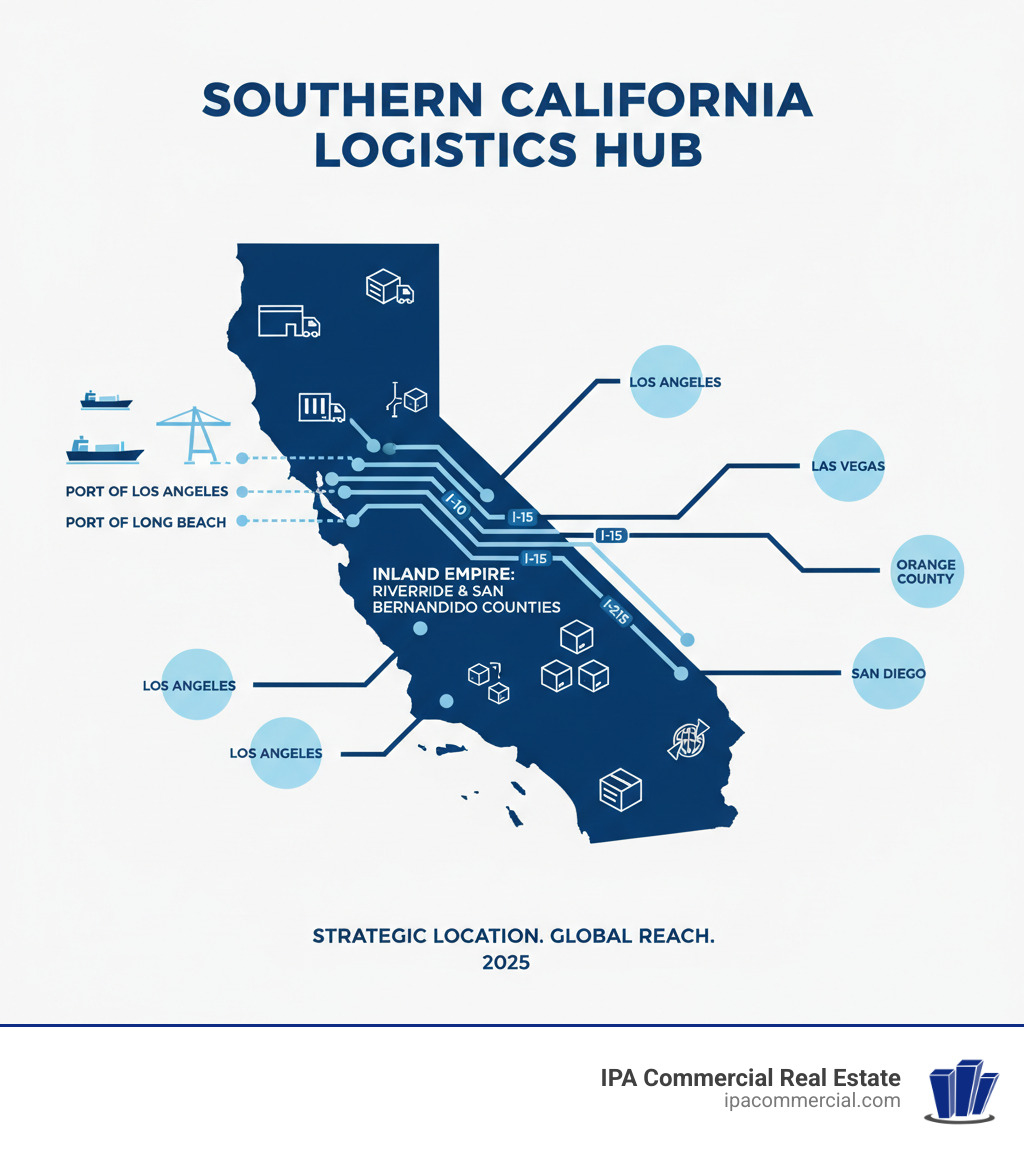
- Strategic Location: Primary logistics hub connecting the ports of Los Angeles and Long Beach to the rest of the nation
- Key Markets: Riverside, Rancho Cucamonga, Ontario, Fontana, and San Bernardino offer diverse commercial opportunities
- Growth Drivers: E-commerce expansion, distribution center demand, and proximity to major transportation corridors
The region’s commercial landscape is evolving. While leasing remains strong for mid-size industrial spaces, the market is adjusting to new construction as companies recalibrate their needs. Industrial properties are central, but opportunities also exist in the office and retail sectors for savvy investors.
The Inland Empire’s compelling dual role as a value alternative to coastal markets and a critical hub for the West Coast supply chain creates unique opportunities. This combination attracts investors seeking stable, income-producing assets backed by strong long-term economic fundamentals.
I’m Matt Morgan, a licensed California Real Estate Salesperson specializing in inland empire real estate since 2008. My experience in commercial property acquisitions, sales, and value improvements across Southern California with IPA Commercial Real Estate provides deep insights into the retail, office, and industrial sectors driving this market.
Decoding the Current Commercial Market Trends
The Inland Empire real estate market is constantly adapting to economic forces. For investors, understanding these shifts is essential. As one of Southern California’s most dynamic markets, the region offers a mix of opportunities across its industrial, office, and retail sectors.
The industrial sector remains the undisputed champion. The region’s role as the logistics backbone connecting the ports of Los Angeles and Long Beach to the nation drives leasing activity, especially for properties between 100,000 and 499,999 square feet. While the West submarket has traditionally led, the East is catching up, indicating that opportunities are spreading.
A strong sign of market confidence is the trend toward longer lease terms. When businesses commit to 10 or 15-year leases, they are betting on the market’s long-term stability, a strong vote of confidence in Inland Empire real estate.
Understanding Key Market Indicators

In Q1 2025, the industrial vacancy rate climbed to 7.6%, largely due to a wave of new construction delivering at once. This new space needs time to be absorbed by the market.
The good news is that net absorption was a healthy 2.2 million square feet for the quarter. This shows that despite new inventory, businesses are actively leasing space and the market is digesting the new supply.
Sublet availability increased to 16.6 million square feet, up 6.7% from late 2024, as major companies adjusted their footprints. For savvy tenants, this creates opportunities, as sublease space often comes with favorable terms and existing improvements.
For more detailed statistics, check out our Data Dive: Understanding Riverside’s Commercial Real Estate Market.
Factors Influencing Commercial Property Values
Several key factors determine a commercial property’s value, and understanding them is crucial for any investment.
Location is fundamental. A warehouse near the I-10/I-15 interchange or an office in a growing business district holds inherent value. The Inland Empire’s strategic position in Southern California, connecting ports and transportation networks, is a primary value driver. We explored this in How to Choose the Perfect Location for Your Retail Business.
Property type shapes a building’s value. Industrial distribution centers command premium prices in the Inland Empire real estate market. Office spaces are being reinvented for hybrid work with flexible layouts and modern amenities. Retail properties depend on community demographics and purchasing power.
Amenities can lift a property. For industrial tenants, this means 32-foot clear heights, ample dock doors, and trailer parking. Office tenants seek conference rooms and fast internet, while retail businesses need visibility and parking.
Finally, zoning regulations dictate a property’s use and development potential. A property zoned for mixed-use may be worth significantly more than one with a single-purpose restriction. Smart investors always understand zoning before buying.
Exploring Investment Hotspots in the Inland Empire
The Inland Empire real estate market is a collection of distinct cities, each with its own commercial character and investment potential. From massive industrial corridors to evolving retail centers, the region offers a full spectrum of commercial property opportunities. Having worked across Southern California since 2008, I’ve seen how each city has carved out a unique economic role. Understanding these differences is key for investors and business owners.
The region’s constant evolution creates opportunities for those with local expertise. An area that was once overlooked might now be a thriving commercial corridor as companies reconfigure supply chains and new developments take shape.
Opportunities in Key Cities
Riverside is one of the Inland Empire’s most diverse commercial markets, offering professional office spaces and retail developments. Our Riverside Commercial Real Estate Brokerage services connect clients with these varied opportunities.
Ontario is synonymous with logistics and distribution in Southern California. The Ontario International Airport and freeway access make it an unbeatable location for supply chain operations. We are deeply involved in the Ontario Commercial Real Estate Brokerage market.
Fontana is a powerhouse for logistics and manufacturing, positioned along the I-10 and I-15 corridors. Our Fontana Commercial Property Management services ensure these critical assets operate smoothly.
Rancho Cucamonga offers a balanced commercial landscape, attracting quality office tenants and serving an affluent consumer base with its retail centers. Our Rancho Cucamonga Commercial Real Estate Brokerage team helps clients steer this diverse market.
San Bernardino remains a vital industrial hub, while Temecula offers unique retail and hospitality-related opportunities due to its growing population and proximity to San Diego. We provide specialized San Bernardino Commercial Real Estate Brokerage and Temecula Commercial Real Estate Brokerage services for these markets.
Evaluating Your Next Commercial Investment
Finding the right property in the Inland Empire real estate market requires a systematic approach. We begin with thorough market analysis, examining vacancy rates, rental trends, and absorption patterns for your target location and property type.
Property valuation is where local expertise matters. Our valuations consider a building’s condition, location, tenant quality, and lease structures, drawing on years of experience in Southern California’s commercial markets. The right price reflects not just today’s market, but a property’s future potential.
Understanding your potential return on investment is critical. We help investors calculate ROI by analyzing acquisition costs, operating expenses, financing, and realistic income projections, as detailed in our guide on Commercial Real Estate Return on Investment.
Successful investments deliver long-term value. We emphasize evaluating a property’s long-term potential by assessing local economic drivers, demographic shifts, and planned infrastructure. These factors can dramatically impact an asset’s performance, a framework we outline in How to Evaluate a Commercial Property’s Long-Term Potential.
A Guide to Navigating the Inland Empire Real Estate Market
Whether buying, selling, or leasing, navigating the Inland Empire real estate market requires the right partner. At IPA Commercial Real Estate, a full-service brokerage, management, and consulting firm in Riverside, we provide personalized, prompt service for commercial real estate transactions across Southern California.
As a Commercial Real Estate Agency, we go beyond transactions. For buyers, we offer experienced guidance to minimize stress and avoid costly mistakes. For sellers, we craft a comprehensive strategy to achieve the best outcome. For landlords and tenants, we connect the right businesses with the right spaces.
Our flexibility and range of value-added consulting services set us apart. We tailor our approach to fit your specific goals and investment strategy in the dynamic inland empire real estate market.
Essential Services for Owners and Investors
Effective management is key to investment returns. The demands of running a commercial property can be overwhelming, which is where our Commercial Property Management services provide peace of mind while enhancing your asset’s value.
We handle everything:
- Marketing Strategies: We use compelling listings and innovative approaches to attract qualified tenants quickly.
- Tenant Screening: Our rigorous process vets potential tenants to ensure they are financially sound and reliable, minimizing risk.
- Rent Collection: We manage rent collection professionally to ensure consistent cash flow.
- Property Maintenance: Through proactive Commercial Property Maintenance and prompt repairs, we keep properties in top condition, protecting your investment.
- Financial Reporting: We provide transparent, detailed statements on your property’s performance.
People often ask, What does a property manager do? We handle the complexities, allowing you to focus on growing your portfolio.
Future Outlook and Emerging Opportunities
The Inland Empire real estate market is constantly evolving. The forces reshaping the commercial landscape are opening doors for investors and businesses who know where to look.
The industrial sector remains the region’s crown jewel, but it’s becoming more sophisticated. Today’s logistics facilities feature advanced automation and sustainability features. Continued e-commerce growth fuels demand for strategically located distribution centers throughout Southern California, especially in the more affordable Inland Empire.
The office sector is undergoing a dramatic shift. Companies are reimagining their space needs, often downsizing their footprint while upgrading quality. The rise of flexible workspaces reflects a broader shift toward adaptability. The office is not dead; boring, cookie-cutter buildings are making way for thoughtfully designed, amenity-rich environments.

Investing in the Future of Inland Empire Real Estate
Capitalizing on these trends requires strategic thinking. The Inland Empire’s fundamentals—population growth, strategic importance to trade, and relative affordability—create a compelling long-term investment thesis.
If you’re new to this space, our guide on Getting Started in Commercial Real Estate Investing can help. The key is a strategic approach: understand your risk tolerance, define your goals, and build knowledge. Commercial property requires due diligence and an experienced team.
The Rise of NNN Lease Properties
One investment strategy gaining momentum in the Inland Empire real estate market is the Triple Net (NNN) Lease. For investors seeking the benefits of ownership without active management, this structure is highly attractive.
In a Triple Net Lease Real Estate arrangement, the tenant covers property taxes, insurance, and maintenance. This provides a passive income stream, popular with investors planning for retirement or diversifying away from actively managed assets.
NNN properties offer predictable cash flow, typically from credit-worthy national tenants on long-term leases. The Inland Empire has excellent opportunities for NNN Lease Properties for Sale, from retail pads to service facilities. While NNN leases have nuances, our NNN Commercial Lease Guide can help investors understand the details. The combination of the Inland Empire’s strong fundamentals and the passive nature of NNN leases creates a compelling investment strategy.
Frequently Asked Questions about Inland Empire Commercial Real Estate
Investors and business owners often have questions about the Inland Empire real estate market. Here are answers to some of the most common ones, based on our experience in Southern California’s commercial property landscape.
What are the primary drivers of the Inland Empire’s commercial real estate market?
The market’s strength comes from a powerful combination of factors:
- Strategic Location: It serves as the primary logistics and distribution hub for Southern California, connecting the busy ports of Los Angeles and Long Beach to the rest of the nation.
- Infrastructure: A network of major transportation corridors, including Interstates 10, 15, and 215, allows for efficient goods movement.
- E-commerce Growth: The expansion of e-commerce has created unprecedented demand for modern warehouse and distribution facilities.
- Population Growth: A growing population fuels demand for retail, office, and other commercial services.
What types of commercial properties are most in-demand in the Inland Empire?
Industrial properties, especially large-scale warehouses and distribution centers (100,000-500,000+ sq. ft.), dominate demand due to the e-commerce boom. However, there is also steady interest in retail spaces in high-growth communities like Rancho Cucamonga and Temecula, catering to expanding populations. The office market is evolving, with demand for flexible Inland Empire Office Space for Rent that offers modern amenities and supports new work models.
How can an investor get started in the Inland Empire real estate market?
Getting started requires a methodical approach. First, conduct thorough market research on trends, vacancy, and rental rates in your target submarket. Next, identify a property type that aligns with your investment goals. Securing appropriate commercial financing is another critical step. Most importantly, partner with a local Commercial Real Estate Consultant with deep knowledge of the Inland Empire. An experienced consultant provides invaluable insights and helps you avoid costly mistakes, guiding you from analysis to closing.
Why Choose IPA Commercial Real Estate?
The Inland Empire real estate market is where strategic location, economic momentum, and opportunity converge. Its industrial strength, growing communities, and critical role in the West Coast supply chain create a market that rewards savvy investors and business owners.
Navigating this complex commercial environment requires a knowledgeable partner. The difference between a good investment and a great one is often local expertise—someone who understands the submarkets and can spot opportunities early.
That’s where IPA Commercial Real Estate comes in. We provide comprehensive brokerage, management, and consulting services custom to the Inland Empire real estate market. Our team’s deep local knowledge, developed over years of living and investing in Southern California, is your advantage. We are strategic partners invested in your long-term success, offering the personalized attention and data-driven advice needed to make sound decisions.
The opportunities are here now, from e-commerce logistics to flexible workspaces and NNN lease properties. The question is whether you have the right team to help you capitalize on them.
Ready to explore what’s possible? We invite you to browse our available properties or reach out directly. Your next strategic move in commercial property starts with a conversation, and we’re here to make it count.