Welcome to our blog.
Sorry, no results were found, search again?
Welcome to our blog.

The Inland Empire has evolved from a logistics corridor into one of Southern California’s most dynamic commercial real estate hubs. With massive population growth, strategic proximity to major ports, and a business-friendly landscape, the region has become a magnet for companies seeking space, scale, and speed. Whether it’s industrial, retail, or office redevelopment, the IE is reshaping how Southern California thinks about expansion.
Today, the Inland Empire stands as a powerhouse of opportunity, driven by record-setting industrial absorption, continued investment in infrastructure, and a growing workforce that fuels long-term growth. As demand pushes outward from Los Angeles and Orange County, developers and investors are finding that the Inland Empire isn’t just a spillover market—it’s a high-performance ecosystem of its own, offering the capacity and momentum modern businesses need to thrive.
Key Inland Empire Commercial Real Estate Facts:
The region’s commercial landscape is evolving. While leasing remains strong for mid-size industrial spaces, the market is adjusting to new construction as companies recalibrate their needs. Industrial properties are central, but opportunities also exist in the office and retail sectors for savvy investors.
The Inland Empire’s compelling dual role as a value alternative to coastal markets and a critical hub for the West Coast supply chain creates unique opportunities. This combination attracts investors seeking stable, income-producing assets backed by strong long-term economic fundamentals.
I’m Matt Morgan, a licensed California Real Estate Salesperson specializing in inland empire real estate since 2008. My experience in commercial property acquisitions, sales, and value improvements across Southern California with IPA Commercial Real Estate provides deep insights into the retail, office, and industrial sectors driving this market.
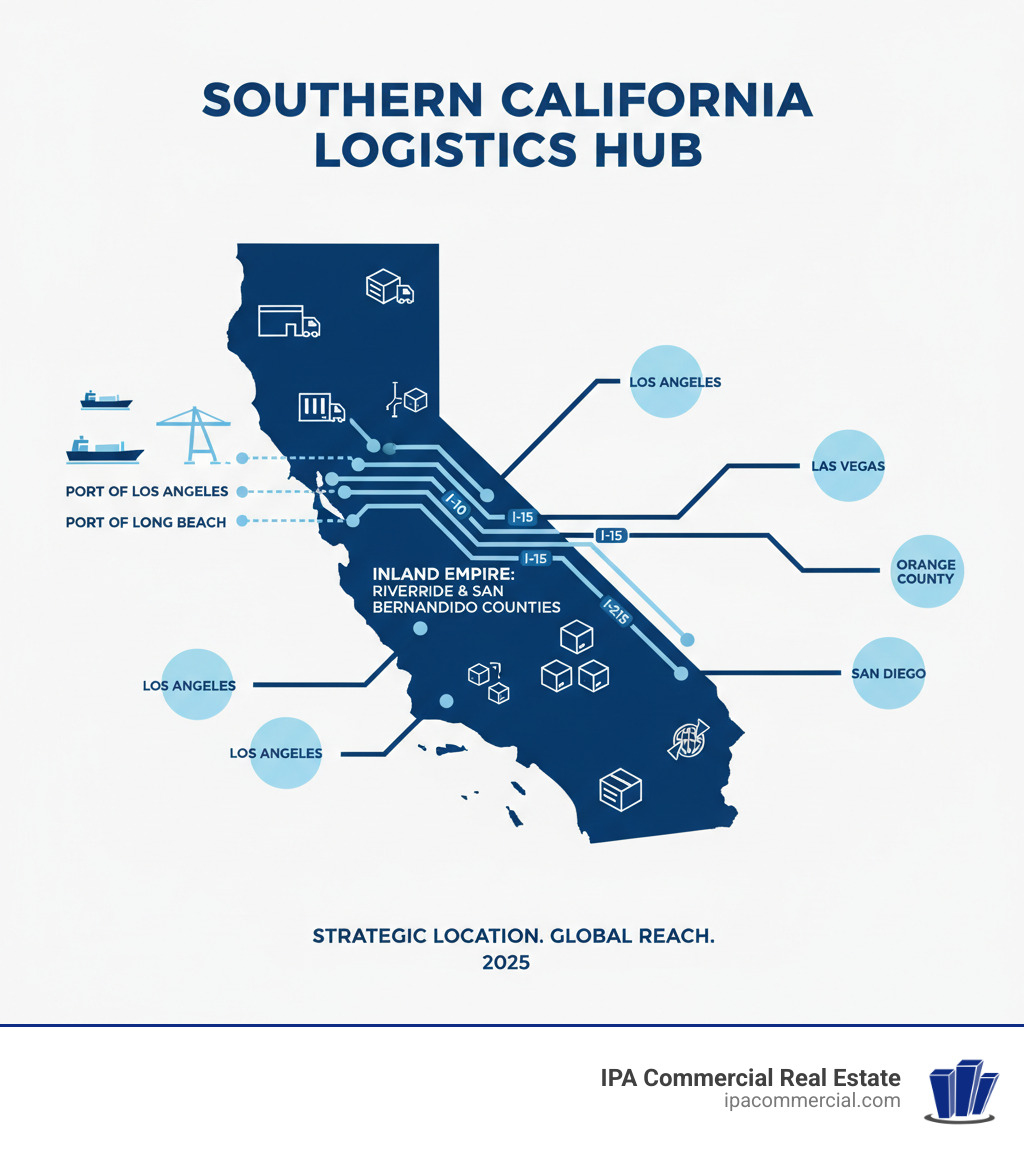
The Inland Empire real estate market is constantly adapting to economic forces. For investors, understanding these shifts is essential. As one of Southern California’s most dynamic markets, the region offers a mix of opportunities across its industrial, office, and retail sectors.
The industrial sector remains the undisputed champion. The region’s role as the logistics backbone connecting the ports of Los Angeles and Long Beach to the nation drives leasing activity, especially for properties between 100,000 and 499,999 square feet. While the West submarket has traditionally led, the East is catching up, indicating that opportunities are spreading.
A strong sign of market confidence is the trend toward longer lease terms. When businesses commit to 10 or 15-year leases, they are betting on the market’s long-term stability, a strong vote of confidence in Inland Empire real estate.

In Q1 2025, the industrial vacancy rate climbed to 7.6%, largely due to a wave of new construction delivering at once. This new space needs time to be absorbed by the market.
The good news is that net absorption was a healthy 2.2 million square feet for the quarter. This shows that despite new inventory, businesses are actively leasing space and the market is digesting the new supply.
Sublet availability increased to 16.6 million square feet, up 6.7% from late 2024, as major companies adjusted their footprints. For savvy tenants, this creates opportunities, as sublease space often comes with favorable terms and existing improvements.
For more detailed statistics, check out our Data Dive: Understanding Riverside’s Commercial Real Estate Market.
Several key factors determine a commercial property’s value, and understanding them is crucial for any investment.
Location is fundamental. A warehouse near the I-10/I-15 interchange or an office in a growing business district holds inherent value. The Inland Empire’s strategic position in Southern California, connecting ports and transportation networks, is a primary value driver. We explored this in How to Choose the Perfect Location for Your Retail Business.
Property type shapes a building’s value. Industrial distribution centers command premium prices in the Inland Empire real estate market. Office spaces are being reinvented for hybrid work with flexible layouts and modern amenities. Retail properties depend on community demographics and purchasing power.
Amenities can lift a property. For industrial tenants, this means 32-foot clear heights, ample dock doors, and trailer parking. Office tenants seek conference rooms and fast internet, while retail businesses need visibility and parking.
Finally, zoning regulations dictate a property’s use and development potential. A property zoned for mixed-use may be worth significantly more than one with a single-purpose restriction. Smart investors always understand zoning before buying.
The Inland Empire real estate market is a collection of distinct cities, each with its own commercial character and investment potential. From massive industrial corridors to evolving retail centers, the region offers a full spectrum of commercial property opportunities. Having worked across Southern California since 2008, I’ve seen how each city has carved out a unique economic role. Understanding these differences is key for investors and business owners.
The region’s constant evolution creates opportunities for those with local expertise. An area that was once overlooked might now be a thriving commercial corridor as companies reconfigure supply chains and new developments take shape.
Riverside is one of the Inland Empire’s most diverse commercial markets, offering professional office spaces and retail developments. Our Riverside Commercial Real Estate Brokerage services connect clients with these varied opportunities.
Ontario is synonymous with logistics and distribution in Southern California. The Ontario International Airport and freeway access make it an unbeatable location for supply chain operations. We are deeply involved in the Ontario Commercial Real Estate Brokerage market.
Fontana is a powerhouse for logistics and manufacturing, positioned along the I-10 and I-15 corridors. Our Fontana Commercial Property Management services ensure these critical assets operate smoothly.
Rancho Cucamonga offers a balanced commercial landscape, attracting quality office tenants and serving an affluent consumer base with its retail centers. Our Rancho Cucamonga Commercial Real Estate Brokerage team helps clients steer this diverse market.
San Bernardino remains a vital industrial hub, while Temecula offers unique retail and hospitality-related opportunities due to its growing population and proximity to San Diego. We provide specialized San Bernardino Commercial Real Estate Brokerage and Temecula Commercial Real Estate Brokerage services for these markets.
Finding the right property in the Inland Empire real estate market requires a systematic approach. We begin with thorough market analysis, examining vacancy rates, rental trends, and absorption patterns for your target location and property type.
Property valuation is where local expertise matters. Our valuations consider a building’s condition, location, tenant quality, and lease structures, drawing on years of experience in Southern California’s commercial markets. The right price reflects not just today’s market, but a property’s future potential.
Understanding your potential return on investment is critical. We help investors calculate ROI by analyzing acquisition costs, operating expenses, financing, and realistic income projections, as detailed in our guide on Commercial Real Estate Return on Investment.
Successful investments deliver long-term value. We emphasize evaluating a property’s long-term potential by assessing local economic drivers, demographic shifts, and planned infrastructure. These factors can dramatically impact an asset’s performance, a framework we outline in How to Evaluate a Commercial Property’s Long-Term Potential.
Whether buying, selling, or leasing, navigating the Inland Empire real estate market requires the right partner. At IPA Commercial Real Estate, a full-service brokerage, management, and consulting firm in Riverside, we provide personalized, prompt service for commercial real estate transactions across Southern California.
As a Commercial Real Estate Agency, we go beyond transactions. For buyers, we offer experienced guidance to minimize stress and avoid costly mistakes. For sellers, we craft a comprehensive strategy to achieve the best outcome. For landlords and tenants, we connect the right businesses with the right spaces.
Our flexibility and range of value-added consulting services set us apart. We tailor our approach to fit your specific goals and investment strategy in the dynamic inland empire real estate market.
Effective management is key to investment returns. The demands of running a commercial property can be overwhelming, which is where our Commercial Property Management services provide peace of mind while enhancing your asset’s value.
We handle everything:
People often ask, What does a property manager do? We handle the complexities, allowing you to focus on growing your portfolio.
The Inland Empire real estate market is constantly evolving. The forces reshaping the commercial landscape are opening doors for investors and businesses who know where to look.
The industrial sector remains the region’s crown jewel, but it’s becoming more sophisticated. Today’s logistics facilities feature advanced automation and sustainability features. Continued e-commerce growth fuels demand for strategically located distribution centers throughout Southern California, especially in the more affordable Inland Empire.
The office sector is undergoing a dramatic shift. Companies are reimagining their space needs, often downsizing their footprint while upgrading quality. The rise of flexible workspaces reflects a broader shift toward adaptability. The office is not dead; boring, cookie-cutter buildings are making way for thoughtfully designed, amenity-rich environments.

Capitalizing on these trends requires strategic thinking. The Inland Empire’s fundamentals—population growth, strategic importance to trade, and relative affordability—create a compelling long-term investment thesis.
If you’re new to this space, our guide on Getting Started in Commercial Real Estate Investing can help. The key is a strategic approach: understand your risk tolerance, define your goals, and build knowledge. Commercial property requires due diligence and an experienced team.
One investment strategy gaining momentum in the Inland Empire real estate market is the Triple Net (NNN) Lease. For investors seeking the benefits of ownership without active management, this structure is highly attractive.
In a Triple Net Lease Real Estate arrangement, the tenant covers property taxes, insurance, and maintenance. This provides a passive income stream, popular with investors planning for retirement or diversifying away from actively managed assets.
NNN properties offer predictable cash flow, typically from credit-worthy national tenants on long-term leases. The Inland Empire has excellent opportunities for NNN Lease Properties for Sale, from retail pads to service facilities. While NNN leases have nuances, our NNN Commercial Lease Guide can help investors understand the details. The combination of the Inland Empire’s strong fundamentals and the passive nature of NNN leases creates a compelling investment strategy.
Investors and business owners often have questions about the Inland Empire real estate market. Here are answers to some of the most common ones, based on our experience in Southern California’s commercial property landscape.
The market’s strength comes from a powerful combination of factors:
Industrial properties, especially large-scale warehouses and distribution centers (100,000-500,000+ sq. ft.), dominate demand due to the e-commerce boom. However, there is also steady interest in retail spaces in high-growth communities like Rancho Cucamonga and Temecula, catering to expanding populations. The office market is evolving, with demand for flexible Inland Empire Office Space for Rent that offers modern amenities and supports new work models.
Getting started requires a methodical approach. First, conduct thorough market research on trends, vacancy, and rental rates in your target submarket. Next, identify a property type that aligns with your investment goals. Securing appropriate commercial financing is another critical step. Most importantly, partner with a local Commercial Real Estate Consultant with deep knowledge of the Inland Empire. An experienced consultant provides invaluable insights and helps you avoid costly mistakes, guiding you from analysis to closing.
The Inland Empire real estate market is where strategic location, economic momentum, and opportunity converge. Its industrial strength, growing communities, and critical role in the West Coast supply chain create a market that rewards savvy investors and business owners.
Navigating this complex commercial environment requires a knowledgeable partner. The difference between a good investment and a great one is often local expertise—someone who understands the submarkets and can spot opportunities early.
That’s where IPA Commercial Real Estate comes in. We provide comprehensive brokerage, management, and consulting services custom to the Inland Empire real estate market. Our team’s deep local knowledge, developed over years of living and investing in Southern California, is your advantage. We are strategic partners invested in your long-term success, offering the personalized attention and data-driven advice needed to make sound decisions.
The opportunities are here now, from e-commerce logistics to flexible workspaces and NNN lease properties. The question is whether you have the right team to help you capitalize on them.
Ready to explore what’s possible? We invite you to browse our available properties or reach out directly. Your next strategic move in commercial property starts with a conversation, and we’re here to make it count.

Identifying undervalued commercial properties before your competitors do takes a sharp combination of research, analysis, and timing. These properties are typically priced below their true market value because of factors like motivated sellers, shifts in market demand, or untapped redevelopment potential. Finding them isn’t about luck—it’s about reading the market better than others. In regions like Southern California’s fast-moving Inland Empire, opportunities often hide in plain sight. Success comes from knowing where to look, understanding the data behind local trends, and recognizing the signs of unrealized value before the rest of the market catches on.
Finding properties below market value isn’t about luck; it’s about developing a process that combines financial analysis, market intelligence, and strategic positioning. The rewards can be substantial, from building instant equity to securing properties with strong cash flow potential.
Here are the essential steps:
I’m Matt Morgan, a licensed California Real Estate Salesperson with IPA Commercial Real Estate since 2008. I’ve spent my career helping investors identify undervalued commercial properties before the competition through acquisitions, sales, and value improvements across Southern California. My expertise in retail and office properties has given me insight into what separates a good deal from a great one in our region’s commercial real estate market.
Thorough market research is the foundation that separates successful investors from those who overpay or miss opportunities. It provides the insights needed to identify undervalued commercial properties before the competition by understanding property demand, local economic conditions, and emerging trends. At IPA Commercial Real Estate, we start every analysis with a deep dive into the data to uncover a market’s real story.
Economic indicators are the vital signs of the commercial real estate market. By monitoring these forces, we can anticipate shifts before they become obvious.
Demographics drive demand. Analyzing population shifts helps pinpoint regions within Southern California, particularly the Inland Empire, that are on an upward trajectory.
Sales comparables (“comps”) are one of the most direct ways to gauge market value and spot potential undervaluation. The process involves comparing your target to similar properties based on size, location, class, and condition.
Price per square foot is a key metric. A property priced noticeably lower than recent comps is a red flag worth investigating. We also analyze recent market trends to see if prices are rising or falling and compare the asking price to the county’s assessed value and sale history. A significant discrepancy can signal a motivated seller.
Financial metrics tell the story that sellers sometimes don’t. By analyzing cash flow, cap rates, and distress signals, we can identify undervalued commercial properties before the competition. These indicators often reveal opportunities that others miss because they aren’t looking in the right places. This is why we always conduct thorough assessments as outlined in How to Analyze Risk Before Purchasing a Commercial Property.
We always start with the fundamentals: cash flow and cap rates.
An undervalued property may have a higher-than-average cap rate for its area, or it may have untapped income potential, such as vacant space or below-market rents.
Some of the best deals in Southern California come from properties that look rough or have motivated sellers. These situations create significant opportunities.

Tracking loan data helps identify distress before it becomes public knowledge.
To truly identify undervalued commercial properties before the competition, you need to go beyond traditional methods. This means uncovering off-market deals, leveraging technology, and understanding development patterns that signal future value. Our experience in Getting Started in Commercial Real Estate Investing has shown that the best deals rarely come from obvious places.
Many owners who are ready to sell never list their properties publicly. These off-market deals offer more room to negotiate favorable terms. Finding them requires a proactive approach:
Technology is changing how investors find opportunities. AI and predictive analytics provide a significant competitive advantage.
These tools work best when combined with traditional appraisals and local market knowledge. Sophisticated data platforms can offer valuable insights into investment opportunities.
Monitoring development is like having a window into the future of property values.
Finding an undervalued property is the first step; the real value creation happens when you transform it. This is where you identify undervalued commercial properties before the competition by seeing potential others miss. Our experience in Southern California Commercial Real Estate has taught us that this requires both vision and meticulous execution.
An older, worn-down building can be a goldmine of opportunity. The key is to envision what a property could become.
Understanding the local regulatory landscape is essential for open uping a property’s hidden value.
Undervalued properties often come with risks that must be managed intelligently.
To consistently identify undervalued commercial properties before the competition, investors must understand the rhythm of the market, recognize economic cycles, and rely on experienced professionals.
Commercial real estate moves through four predictable phases. Understanding them is key to timing investments.
Patience is a cornerstone of successful commercial real estate investing. A long-term view allows investors to benefit from compounding returns and weather short-term market fluctuations.
Instead of chasing quick profits, we focus on properties with strong fundamentals—prime locations, quality construction, and resilient tenants. These assets perform well over the long haul, regardless of short-term market noise. A long-term hold strategy allows investors to fully capture the appreciation potential in growing regions like Southern California.
Working with an experienced professional from a reputable Commercial Real Estate Brokerage is one of the smartest strategies for finding undervalued properties.
A skilled broker provides:
At IPA Commercial Real Estate, our team embodies these qualities. We believe partnering with a professional who understands your goals and knows how to identify undervalued commercial properties before the competition makes all the difference.
While many factors are important, location is the foundation upon which all other value is built. A property’s location determines its accessibility, growth potential, and market demand. An underperforming property in a prime or transitioning location holds immense potential for value creation, whereas even a perfect building in a declining area will struggle to appreciate. In Southern California, a dated building in a revitalizing neighborhood can be a goldmine. For more insights, check out Location Matters: More Than Ever, Is Your Business in the Right Space?.
There is no single “good” cap rate; it’s highly dependent on context. A good cap rate is one that offers a favorable return relative to the property’s risk and aligns with your investment strategy.
The ability to identify undervalued commercial properties before the competition is a skill built on a systematic approach that blends data-driven analysis with market intuition. It requires thorough research into economic and demographic trends, a deep dive into financial metrics like cap rates and cash flow, and the use of advanced strategies to find off-market deals and anticipate future growth.
Successful investors see potential where others see problems, changing properties through renovation, repositioning, or adaptive reuse. This process requires navigating local regulations in Southern California, conducting meticulous due diligence, and maintaining a long-term perspective that weathers market cycles.
Perhaps most importantly, it requires the right partner. At IPA Commercial Real Estate, we’ve spent years developing the skills and networks to uncover hidden opportunities in the Southern California market. Our deep knowledge of the Inland Empire, combined with our commitment to personalized service, helps our clients turn good deals into great investments.
Ready to find the opportunities others are missing? Contact our team for expert property management services and let’s start uncovering the hidden gems in today’s commercial real estate market together.


Understanding the impact of professional property management is essential for any commercial real estate investor. From the moment they step in, experienced managers bring measurable value—streamlining operations, protecting your investment, and enhancing long-term returns. They identify inefficiencies, reduce operating costs, and implement strategies that strengthen tenant satisfaction and asset performance from day one.
Owning commercial property in Southern California’s Inland Empire is lucrative, but self-management is a demanding job. It involves handling tenant issues, navigating complex laws, coordinating repairs, and managing finances. This often becomes a time-consuming burden, pulling investors away from growing their portfolios.
The financial stakes are high. A vacant space means lost rent, a legal misstep can lead to expensive lawsuits, and deferred maintenance erodes property value. Hiring professional management isn’t just about convenience—it’s about protecting and maximizing your investment from day one.
Professional managers bring immediate operational efficiency. They handle lease negotiations, rent collection, maintenance, and tenant relations. Their local market expertise, vendor relationships, and financial systems ensure your property performs optimally from the start, avoiding costly trial and error.
I’m Matt Morgan, a licensed California Real Estate Salesperson with IPA Commercial Real Estate. Since 2008, I’ve specialized in commercial properties with a focus on acquisitions, tenant relations, and strategic value improvements. Over the years, I’ve seen firsthand how the right property management team can elevate an asset’s performance almost immediately—streamlining operations, reducing inefficiencies, and creating long-term stability that benefits both owners and tenants.
When a professional management team takes over your commercial property, the financial and operational upgrades are immediate, producing measurable results from day one.
Your Net Operating Income (NOI) becomes our primary focus. We achieve this by strategically increasing occupancy and optimizing rental income while simultaneously reducing unnecessary operating expenses. This dual approach means your investment starts working harder for you immediately.
Many investors in Southern California find themselves overwhelmed by day-to-day operational demands—tenant inquiries, maintenance issues, and complex lease negotiations. Professional property managers deliver immediate value by serving as the essential buffer, taking on these time-consuming responsibilities so investors can focus on growth, strategy, and maximizing returns.
We act as strategic partners who align our management services with your broader investment objectives. Whether you’re looking to expand your holdings across the Inland Empire or simply want to reclaim your time, professional management delivers the financial clarity and operational efficiency to make those goals achievable.
Setting rental rates is a data-driven process requiring deep market knowledge. Price a unit too high, and it sits vacant; price it too low, and you lose potential income.
Our team conducts thorough market analyses, examining comparable properties throughout Riverside and the Inland Empire and analyzing current demand trends. We use professional valuation tools to pinpoint the optimal price point, positioning your property to attract quality tenants quickly while maximizing revenue.
Vacancy reduction is where strategic pricing pays off. We know that finding a great commercial tenant is critical. Our targeted marketing strategies ensure your spaces reach the right decision-makers through compelling descriptions, high-quality visuals, and online advertising. Every day a unit sits empty is lost revenue, so we move fast.
We also conduct annual rental appraisals to ensure your property stays competitive as market conditions evolve. Our ongoing market intelligence keeps you ahead of these dynamics. Our expertise in lease negotiation means we attract businesses that will pay on time, maintain your property, and ideally renew their leases. Understanding what makes a good commercial tenant helps us screen effectively and protect your investment from the start.
A typical day of self-management can involve a flood of tenant calls about maintenance, rent collection follow-ups, and vendor approvals—all before lunch.
Professional property managers handle all of this so you don’t have to. We establish efficient rent collection systems and follow up promptly on late payments. We become the primary point of contact for all tenant communication, fielding questions and requests. We coordinate all maintenance needs, from routine service to emergencies, using our vetted vendor network to ensure quality work at fair prices.
The administrative burden alone can consume hours each week. We prepare annual budgets, draft lease agreements, maintain detailed records, and compile financial reports. These tasks are essential but time-consuming if you’re handling them yourself.
Perhaps most importantly, professional property managers shield you from around-the-clock emergency calls. When a tenant faces an issue on a weekend or after hours, they call us—not you. This instant relief is a key way property managers deliver value from day one. By handling tenant communications efficiently and professionally, we ensure every concern is addressed promptly, maintaining tenant satisfaction and protecting your investment. For a complete breakdown of these responsibilities, see What Does a Property Manager Do?.
Self-managed properties often lack financial clarity. Disorganized receipts and sporadic expense tracking can lead to a nightmare at tax time.
Professional property managers bring sophisticated accounting systems from day one. We establish comprehensive budgets, track every payment and expense, and maintain accurate financial records that stand up to scrutiny.
You receive clear, understandable financial statements on a regular schedule, including Balance Sheets, Profit & Loss Statements, and Cash Flow Statements. These are strategic tools that help you understand your property’s performance and make informed decisions.
This level of financial management maximizes the tax effectiveness of your property. We maintain all necessary documentation organized for your accountants, ensuring you can claim every legitimate deduction. Our systems are designed to meet IRS guidance on rental real estate from the start.
Protecting your investment is one of the most important ways professional property managers deliver value from day one. By maintaining your property’s physical condition, they not only preserve its current market value but also enhance its long-term appeal and profitability, ensuring your asset remains competitive and attractive to tenants.
Without proper attention, small issues become big problems. A minor leak can lead to major water damage, and deferred maintenance erodes property value while disrupting tenants. Our approach focuses on proactive care, not reactive scrambling.
From the moment we begin, we implement systems to monitor your property’s condition through regular inspections and scheduled maintenance. We find and fix issues before they affect your bottom line. This commitment to vigilant oversight is essential to How Professional Property Management Protects and Increases Asset Value.
Our role goes beyond keeping the lights on. We actively manage your property’s physical well-being to ensure it remains attractive to quality tenants and competitive in the Southern California market. Strong curb appeal and well-maintained facilities signal a professionally managed property worth leasing.
The difference between good and great property management is being proactive. We don’t wait for systems to fail. We implement preventative maintenance schedules to keep your property running smoothly and help you avoid expensive emergency repairs.
Consider the cost difference: a quarterly HVAC filter change is minor, while replacing a neglected unit costs thousands and creates unhappy tenants. Our routine inspections catch these issues early when they’re still manageable and affordable.
We have spent years building a network of vetted contractors and vendors throughout Riverside and the Inland Empire. These are trusted partners who respond quickly, deliver quality work, and offer competitive pricing. When an emergency occurs, we can mobilize the right professionals immediately, minimizing disruption.
Our expertise in Commercial Property Maintenance means we understand the unique needs of commercial buildings. We know tenants depend on your property to run their businesses, so reliability is essential. This philosophy of Preventive Maintenance vs. Reactive Repairs in Commercial Buildings saves our clients money while preserving property condition. Regular upkeep also impacts tenant satisfaction and retention.
While routine maintenance keeps your property running, strategic capital improvements position it for growth. These are investments that can significantly increase your property’s value and rental income.
We approach capital planning with your long-term financial goals in mind, helping you evaluate each potential project based on its likely ROI and alignment with market demands in Southern California. Should you modernize a lobby, upgrade to energy-efficient lighting, or improve parking?
Our project management expertise ensures that capital improvements are executed efficiently. We coordinate with contractors, manage budgets, monitor timelines, and minimize disruption to existing tenants. A well-coordinated renovation demonstrates your commitment to quality space and can strengthen tenant loyalty.
The key is understanding which improvements will genuinely improve your property’s appeal and value. Upgrading building systems for ADA compliance is essential, while modernizing common areas can make your property more competitive. Professional coordination ensures the work is done correctly and cost-effectively, making improvements that genuinely increase your property’s Net Operating Income and market value.

Owning commercial property in Southern California means navigating a complex and ever-changing landscape of laws and regulations. Professional property managers provide immediate value by shielding you from legal risks and ensuring full compliance—handling everything from lease agreements to safety codes—so your investment stays secure and above reproach.
Ignoring these laws can lead to hefty fines, expensive lawsuits, and tenant disputes. Our team at IPA Commercial stays on top of all state and local rules affecting commercial properties in the Inland Empire and Southern California, including eviction procedures and ADA compliance. Our deep knowledge shields your investment from legal challenges. A strong grasp of landlord-tenant laws and fair housing regulations is essential.
Southern California’s landlord-tenant laws are complex and constantly changing, requiring full-time attention to stay current. Our property managers are experts in these laws, knowing the ins and outs of commercial leases, including how to handle eviction procedures correctly, ensure full lease compliance, and manage ADA compliance.
We understand that breaking these rules, even accidentally, can cause major headaches. Our expertise is vital. We ensure your commercial property follows every legal guideline, from the initial lease agreement to resolving disputes. This is all part of our commitment to commercial property management best practices.
Choosing the right commercial tenant is crucial for protecting your investment. Our rigorous screening process selects high-quality businesses, ensuring steady income and a well-maintained property.
Our thorough screening includes comprehensive background checks, a detailed look at their credit and financial history, and an assessment of their business viability. This helps us ensure prospective tenants are stable and able to meet their lease payments. This careful approach attracts quality tenants who are more likely to pay on time and care for your property. By lowering the risk of problem tenants, we help you avoid costly turnover and potential defaults. We also ensure compliance with laws like the Fair Housing Act and ECOA, reducing your risk of unintentional discrimination and helping you avoid common property management mistakes when self-managing.
Tenant relationships are just as important as the physical property when it comes to long-term success. Professional property managers deliver immediate value by fostering strong tenant connections from day one. Satisfied tenants are more likely to stay, reducing costly vacancies and minimizing turnover expenses, while contributing to a stable, thriving rental environment.
We make tenant satisfaction a top priority through clear communication, a professional approach, and quick problem-solving. This boosts your property’s overall value. When issues are handled promptly and fairly, tenants are more likely to renew their leases, keeping your spaces filled and your income steady. We also foster a sense of community within multi-tenant properties, which improves the business environment for everyone.
We serve as the professional point of contact for all your commercial tenants, handling everything from everyday inquiries to urgent issues with consistent and professional responses.
We also play a crucial role in mediating any disagreements that might arise, acting as a helpful buffer. This allows you to keep a comfortable distance while knowing that all issues are being handled fairly and expertly. Our managers are skilled in solving problems with a professional touch. Tenants get faster responses to their needs, which leads to higher satisfaction and helps resolve problems without personal conflicts. To learn more about our approach, check out our Tenant Relations Management services.
Long-term tenant retention comes down to responsive service, well-maintained facilities, and clear communication—all areas where professional managers excel. When commercial tenants feel valued and know their needs are met quickly, they are far more likely to renew their leases. This is a proactive strategy for tenant satisfaction that boosts occupancy rates.
We understand that happy tenants stay longer and are more likely to recommend their commercial space to others, which translates into better property values and a more stable income stream. Our lease renewal processes are smooth, and we constantly work to understand What Tenants Really Want to ensure their ongoing happiness. By minimizing costly vacancies, we help ensure your property generates consistent revenue from day one.
A professional property manager justifies their fee by strategically improving your property’s performance from the start. We immediately boost your revenue while cutting expenses and risks, making our fee an investment that quickly pays for itself.
From day one, we conduct a thorough market analysis to set competitive rental rates, ensuring your spaces are priced to attract quality tenants quickly. Our targeted marketing fills vacancies faster, saving you from costly empty periods.
Beyond financial gains, we take on all time-consuming daily operational tasks. This frees up your time to focus on growing your portfolio. Preventing costly mistakes in legal compliance and maintenance provides a benefit that can far exceed the management fee. In short, the improved performance and reduced stress make professional management a wise investment. You can learn more about our Commercial Property Management Fee Schedule.
Yes, increasing resale value is another major way professional property managers create immediate impact. By prioritizing the long-term health and performance of your asset, they help boost Net Operating Income (NOI) and maintain the property’s condition—both critical factors that enhance valuation and ultimately command a higher resale price when the time comes.
We achieve this through strategic maintenance plans that keep your property in top condition and prevent expensive, unexpected repairs. We also oversee capital improvements, choosing upgrades strategically for their return on investment (ROI). By maintaining high occupancy with quality tenants and ensuring legal compliance, we create a stable, attractive asset that appeals to potential buyers. This is a core part of How Professional Property Management Protects and Increases Asset Value.
Managing commercial property in the Inland Empire and Southern California requires specialized knowledge of the unique market dynamics and regulatory landscape. Our region has distinct economic drivers, tenant demographics, and a complex web of local and state laws.
This is where a professional property manager provides critical localized expertise. We possess in-depth knowledge of specific local and state laws, including nuances in commercial leasing and zoning regulations. Plus, we have an established network of trusted local vendors, contractors, and legal professionals. This localized approach ensures your property benefits from custom strategies, optimal rental pricing, and efficient operations designed for success in Southern California. To learn more, explore our Locations.
At IPA Commercial Real Estate, we’ve built our reputation on personalized and prompt service throughout Riverside and the Inland Empire. We understand that every property is unique, and every owner has different goals. We bring our extensive knowledge and value-added consulting services to create a management approach customized to your needs.
When you partner with us, you gain a strategic ally committed to your success. We become an extension of your business, working to maximize your returns, preserve your asset, and steer the Southern California commercial market with confidence.
Ready to experience the immediate value that professional property management brings? We’d love to show you how we can transform your commercial property’s performance starting on day one. Contact our team to learn more about our commercial property management services.